Behind every successful business is a team of talented individuals who bring the right skills, experience, and dedication to their roles. But finding these individuals isn’t always easy. For growing organisations in Uganda and across Africa, evaluating job applicants can quickly become one of the most demanding responsibilities for HR teams.
With dozens of CVs to review, interviews to schedule, and candidates to compare, making the right hiring decision can feel overwhelming. And when evaluations rely on manual processes or personal impressions, businesses risk overlooking qualified candidates.
So, how can organisations improve candidate evaluations during recruitment? The answer lies in combining structured hiring practices with smart recruitment technology that makes the process faster, fairer, and more consistent.
Why Candidate Evaluation Matters in Recruitment
Candidate evaluation is the process of assessing job applicants’ qualifications, skills, experience, and suitability for a particular position.
Imagine two applicants competing for the same role. One has impressive academic qualifications, while the other brings valuable practical experience. Without clear evaluation criteria, determining who is better suited for the position can be challenging.
Poor candidate evaluations can lead to hiring mistakes, increased recruitment costs, and reduced workplace productivity.
However, when businesses establish consistent assessment standards, they can make more informed hiring decisions and identify talent that supports long-term growth.
A Day in the Life of an HR Manager Using PahappaHR
Meet Grace, an HR manager at a growing company in Kampala with over 40 employees.
Her organisation recently advertised an administrative officer position, attracting dozens of applications. Previously, Grace spent hours reviewing CVs, comparing qualifications, and coordinating interviews through emails and spreadsheets.
The process was exhausting. Some applications were hard to track, interview schedules often needed adjusting, and comparing candidates objectively was challenging.
But with PahappaHR, Grace’s workflow becomes much more manageable.
Instead of manually reviewing every application from scratch, she can use automated screening to help identify candidates who meet the position’s requirements.
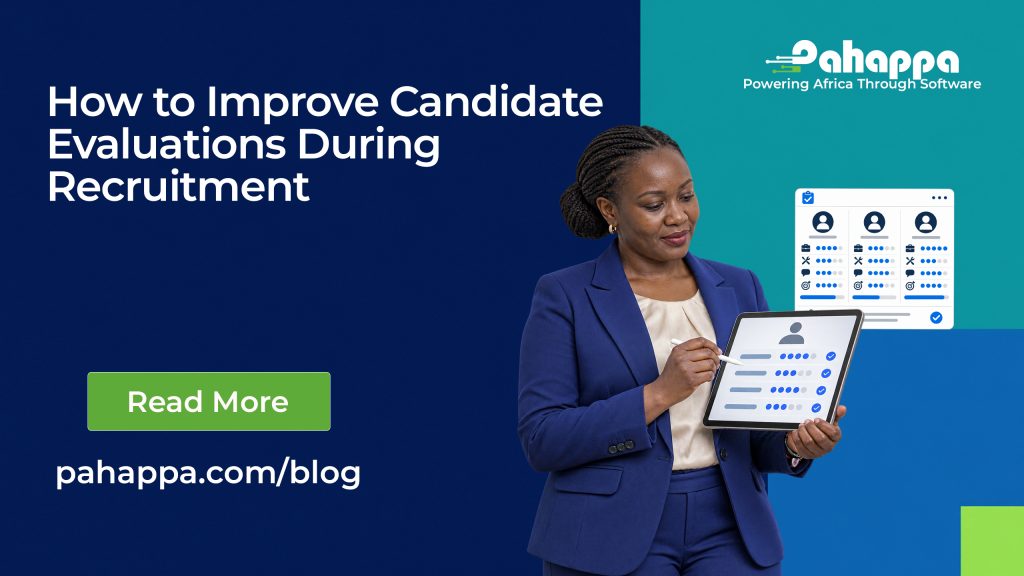
Using applicant scoring and candidate ranking features in PahappaHR, she compares applicants against defined criteria, making it easier to identify promising candidates for further evaluation.
When it’s time for interviews, the interview scheduling feature helps Grace coordinate the next stage without relying entirely on back-and-forth communication.
Instead of spending most of her day on administrative tasks, Grace can focus on understanding candidates’ abilities and making thoughtful hiring recommendations.
For Grace, recruitment becomes more organised. For her organisation, it creates a more consistent approach to identifying the right talent.
5 Ways to Improve Candidate Evaluations During Recruitment
Establish Clear Candidate Evaluation Criteria
Every effective recruitment process begins with knowing what you’re looking for.
Before reviewing applications, HR teams should define the qualifications, technical skills, experience, and competencies the position requires.
For example, when recruiting an accountant, evaluation criteria might include financial reporting knowledge, analytical abilities, and attention to detail.
With PahappaHR, recruiters can assess candidates against established requirements rather than relying solely on personal impressions.
This creates a more consistent foundation for comparing applicants and making informed hiring decisions.
Automate Initial Candidate Screening
Manually reviewing large numbers of applications can take valuable time, especially when organisations are recruiting for multiple positions.
Automated screening helps HR teams identify applicants who meet predefined job requirements.
With PahappaHR, recruiters can streamline initial screening and spend more time evaluating candidates whose qualifications align with the position.
However, automation works best when screening criteria are relevant, transparent, and regularly reviewed to avoid unintentionally excluding qualified applicants.
Use Structured Interviews and Practical Assessments
An impressive CV doesn’t always reveal how effectively someone can perform a job.
Structured interviews allow recruiters to ask consistent, job-related questions and evaluate responses using predefined scoring guidelines.
Practical assessments provide another opportunity to understand candidates’ abilities.
For instance, a customer service applicant might handle a simulated customer complaint. At the same time, an administrative officer could complete a document management exercise.
PahappaHR can help HR teams coordinate interviews more efficiently, so they can focus on meaningful candidate assessments.
Compare Candidates Using Objective Scoring and Ranking
Have you ever interviewed several promising candidates and struggled to decide who performed best?
Without a consistent comparison method, hiring decisions can become subjective.
Candidate scoring and ranking provide a more structured way to evaluate applicants against a position’s requirements.
PahappaHR supports applicant scoring and candidate ranking, helping recruitment teams organise their evaluations and identify candidates who deserve further consideration.
However, rankings should support human judgment rather than replace it. HR managers should still consider practical assessment results, interview performance, and the context behind each candidate’s experience.
Use Recruitment Insights to Improve Future Hiring
Candidate evaluation shouldn’t end when an offer letter is signed.
Organisations can learn from recruitment outcomes by examining how newly hired employees perform after joining the team.
Are new employees meeting expectations? Are certain skill gaps appearing repeatedly? Could the evaluation criteria be improved?
PahappaHR’s broader HR management capabilities, including performance management and staff data management, can support ongoing employee monitoring and workforce planning.
By reviewing relevant performance information, HR teams can refine their hiring criteria and make better-informed recruitment decisions over time.
Why PahappaHR Stands Out in Recruitment Management
PahappaHR goes beyond organising applications. Its recruitment and onboarding capabilities support important stages of the hiring process, from initial candidate screening to applicant evaluation and interview coordination.
With automated screening, applicant scoring, candidate ranking, and interview scheduling, HR teams can reduce repetitive administrative work while maintaining greater consistency in recruitment.
Once candidates become employees, PahappaHR’s payroll, leave, attendance, performance, and staff data management features help organisations manage their growing workforce.
Its subscription-based model and customer support also make it an option worth considering for businesses seeking an integrated HR management solution.
For organisations with growing teams, this means recruitment and employee management can be approached as connected parts of the same workforce strategy.
Conclusion
Improving candidate evaluations during recruitment requires more than reviewing CVs and conducting interviews. It involves establishing clear criteria, assessing practical abilities, comparing candidates consistently, and using technology to support better decisions.
By combining structured recruitment practices with automated screening, applicant scoring, candidate ranking, and interview scheduling features in PahappaHR, organisations can make the hiring process more organised and efficient.
Ultimately, successful recruitment isn’t just about filling vacancies. It’s about identifying people who can contribute to a stronger, more productive workforce.
Ready to make recruitment easier and more effective? Schedule a free PahappaHR demo today to discover how it can support your hiring process.